Navigating the future of turbomachinery: Innovation driven by data, simulation, and AI.

Turbomachinery represents one of the most challenging and sophisticated fields of modern engineering. Its development demands operation under extreme conditions of temperature, pressure, and speed, imposing stringent requirements on materials, mechanical design, and operational reliability.
Currently, jet engines and other turbines operate at temperatures exceeding 1,500 °C and under severe pressure levels, in regimes that surpass the conventional limits of most materials. Even so, these systems must maintain high efficiency, structural integrity, and low weight, especially in aeronautical applications. In this context, the advancement of turbomachinery depends directly on the ability to understand, predict, and control the behavior of its components and operating phenomena through experimental testing, rigorous simulations, and the continuous building of knowledge over time.

Several engineering disciplines need to work together to create a gas turbine
In other words, artificial intelligence needs good input data. The difference is that modern AI can process more data, learn from it faster, and apply those lessons on an unprecedented scale, shaping the future of turbomachinery in ways we are only beginning to understand.
The hurdles OEMs face in a fast-paced world

The future of turbomachinery depends on balancing multiple engineering challenges; all must be optimized simultaneously
Today's turbomachinery manufacturers and suppliers face an ambitious challenge: designing and producing engines that are more flexible, more powerful, larger, with faster launch times, more sustainable, quieter, lighter, and with optimized cooling. Optimizing one attribute often means making concessions in another, requiring sophisticated tools and specialized knowledge to achieve the perfect balance. This balance will define the future of turbomachinery development.
Furthermore, disconnected workflows between design and manufacturing create a problem. They disrupt the knowledge chain that should flow from design to production. When a design team in one location uses different tools and data standards than the manufacturing team in another, performance information is lost in translation. This can lead to inefficiencies, rework, and costly delays, including project launch delays, due to a lack of continuous information flow.
Unplanned downtime can result in high costs for everyone involved. Accurately estimating the detailed thermal performance of subsystems, especially critical components such as cooled turbine blades and vanes, requires managing a complex convergence of CAD, aerodynamics, mechanical integrity, and aeromechanics. Each of these disciplines brings its own challenges, best practices, and the need to push boundaries through research to create the best possible engine.
Siemens' Plan for Accelerated Innovation and the Future of Turbomachinery
At Siemens, overcoming these challenges is considered to lie in a holistic approach that integrates cutting-edge technology with intelligent workflows. The proposed answer is integrated, AI-driven performance engineering, a robust convergence capable of dramatically accelerating innovation cycles while preserving the accumulated experience throughout engineering history. The so-called digital thread is often cited as the cornerstone of the future of turbomachinery engineering.

The future of turbomachinery depends on seamless digital integration, from design to manufacturing
Integrated information throughout the entire product lifecycle, from design to manufacturing, means connecting the CAE-CAD-CAM chain, drastically reducing production cycles and fostering a truly collaborative environment. But fundamentally, it means creating a single source of truth for all relevant data: design intent, simulation results, manufacturing tolerances, production variations, and ultimately, real-world performance.
A comprehensive approach is adopted in which various engineering disciplines converge—aerodynamics, structures, thermodynamics, acoustics, and materials science—enabling holistic improvements. It ensures that every design decision is made with a complete understanding of its impact across all domains. When adjusting the geometry of a blade, it is necessary to immediately understand not only the aerodynamic benefits but also the structural implications, thermal consequences, and manufacturing feasibility. This requires that all relevant data be up-to-date, accurate, and readily available.

Simulations of Combustion Turbine Interaction
The era of isolated tools and fragmented workflows is over. This harmonized environment connects the tools, enabling automation and the exploration of large-scale analyses. When tools are disconnected, data is translated and re-entered multiple times, introducing errors and reducing the fidelity of the information flowing through the system. Unified tools preserve data integrity.
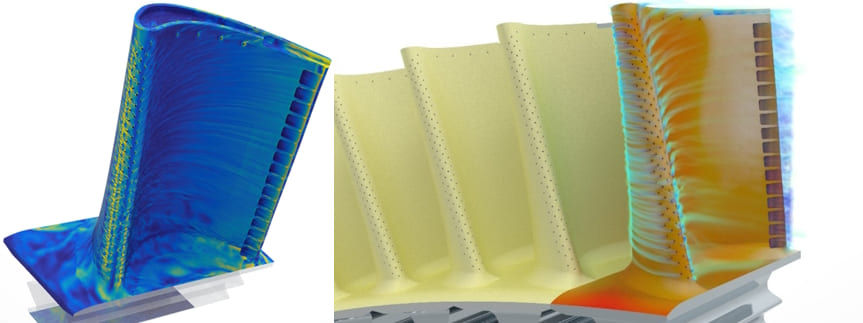
Efficiency of Film Cooling Using Large Vortex Simulations
Engineers are empowered with fast and accurate simulations, democratizing advanced simulation capabilities that lead to accelerated engineering insights and continuous development of parts and assemblies. Speed is important, but accuracy is what truly matters. A fast simulation based on low-quality input data can lead to misinterpretations. Therefore, the goal is to ensure that the simulations performed are fast and reliable, based on validated models and high-quality input data.
By combining virtual and physical tests, robust evidence of conformity is built. Simulations complement tests, but do not replace them. Data obtained from physical tests validate simulations, while validated simulations allow for the exploration of designs that would otherwise require physical testing. In this way, a virtuous cycle of progressively more accurate models and increasingly reliable decisions is established.

AI-trained bird strike simulations and a testing platform for engine certification and verification
Through the Siemens Xcelerator, manufacturing is transformed with an AI-based digital thread that creates a complete end-to-end connection between domains, from design to manufacturing. This encompasses CAD design and multiphysics optimization (noise, vibration, force, fluid, pressure, temperature) through CAM programming, data management, planning, CNC machining, and inspection.

Gear pumps with optimized topology, 3D printing, and CNC simulations exemplify the future of turbomachinery: 80% faster when trained by AI
The transformative power of AI and machine learning, based on solid data
A machine learning model capable of predicting the fatigue life of turbine blades does so based on training performed using historical data on blade materials, operating conditions, failure modes, and observed results. The better the quality of this data, the more accurate the predictions tend to be, and the greater the reliability in defining the future direction of turbomachinery.
The power of AI is combined with simulation to deliver better performance faster. AI-powered design exploration enables automated and intelligent optimization, helping engineers discover the best designs at each stage.

Artificial Intelligence (AI) from Physics Trained on Common Manufacturing Deviations and Operational Defect Simulations
Surrogate models are used for complex analyses, such as 3D finite element creep analysis, providing high accuracy in predicting critical locations and values and significantly accelerating these time-consuming processes. These surrogate models are trained with high-fidelity simulation data; essentially, they learn the patterns that detailed physical simulations would capture. But, again, their accuracy depends entirely on the quality of the training data.
Industry leaders are seizing every opportunity for data reuse, adopting AI at an accelerated pace through simulation with configuration management. Siemens Energy, for example, uses the HEEDS AI predictive simulator to streamline the integration of CAD and CAE processes across various engineering disciplines.

Optimization of multidisciplinary projects accelerated by AI predictions
Ready to tackle the most complex challenges in turbomachinery development with greater efficiency, integration, and innovation? Schedule a meeting with CAEXPERTS and discover how our solutions in simulation, integrated engineering, and digital transformation, such as Simcenter 3D and Simcenter STAR-CCM+, can accelerate your projects, reduce risks, and take your results to a new level.
WhatsApp: +55 (48) 98814-4798
E-mail: contato@caexperts.com.br


