Green hydrogen production simulation within Simcenter Amesim

A strong rise of the interest in green hydrogen production
The demand for today and the future is for true zero-emission power. Alternatives must be found to replace fossil fuels. Currently, batteries are a solution for automotive. Unfortunately, they are not suitable for many applications due to limitations with storage capacity, lifetime, charge constraints and environmental concerns. Therefore, green hydrogen production (produced for instance by electrolysis, using renewable electricity) is identified as a promising solution for long-term zero-emission renewable energy storage.
In 2019, the power generated thanks to hydrogen had the order of magnitude of the power delivered by a modern nuclear plant. And for a few years, hydrogen consumption rose rapidly. This trend will continue to grow significantly as many countries have recently committed large investments to increase hydrogen production and usage for transportation, energy or the industry.

Fig. 1: Evolution of hydrogen consumption
Most hydrogen is still produced from fossil fuels, which means that new infrastructures must be developed with the following challenges:
Green hydrogen production, without any CO₂ emissions. Water electrolysis is one solution, using clean electricity generated for instance from wind turbines, solar panels, wave converters or a combination of these.
The improvement of the system performances, reliability and efficiency in order to reach an acceptable price for the produced hydrogen
The storage of the hydrogen. As this gas has a poor mass energy density in ambient conditions, it is usually compressed or liquefied for storage.

Fig. 2: Hydrogen production plant
So, how do we address these challenges, capture the behavior of a hydrogen production plant and each of its subsystem?
A model combining all subsystems to evaluate global performances
Green hydrogen production simulation within Simcenter Amesim is the solution. It makes it possible to capture the complete process of green hydrogen production, predict interactions between subsystems and the global performances.

Fig. 3: Hydrogen production plant model in Simcenter Amesim
Let's now move on to analyzing the example of electricity generated from 3 different green sources:
Wind turbines
Solar panels
Wave converters
The electric power is used to power an electrolyzer generating hydrogen. The hydrogen is finally compressed in order to store it in high pressure tanks, ready to be used, refuel vehicles or to be transported.
Wind Turbines
The wind turbine model takes into account the number of wind turbines we wish to use, the definition of the turbine geometry (especially the propeller diameter, the angle of inclination…), the generator performance, the losses of the subcomponents and the control of the propeller pitch.

Fig. 4: Wind turbine model
This model makes it possible to predict, for instance, the electric power and the mechanical power of the turbine depending on the wind transient speed.

Fig. 5: Wind turbine model results
Solar panels
The solar panel model is taking into account the number and geometries of cells and panels, the transient operating conditions: considering the evolution of the sun position and the impact of clouds and the definition of the solar array performances.

Fig. 6: Solar panels model
It makes it possible, for instance to predict the electric power delivered by the solar panel, depending on the transient irradiation power on the cells.

Fig. 7: Solar panels model results
Wave Generator
To predict the performance of a wave generator, a highly detailed multiphysics model was initially built. This model reproduces the detailed architecture of the system, considering the sizing and behavior of the subsystems: the piston, valves, hydraulic motor and generator, an accumulator, piping, etc. The model takes into account transient operating conditions with variable wave frequency and amplitude.
This model is accurate and useful for the detailed design and optimization of the wave generator. However, for long-duration simulations, it remains slow.
Then, in a second stage, starting from the accurate model, a reduced model was built using the Simcenter Amesim Neural Network Builder tool. The Neural Network Builder allows training a reduced model easily and quickly, generating the corresponding Amesim model that will run very quickly. In a validation simulation, the reduced wave generator model managed to reproduce the results of the initial model with a 94% confidence level, with a significantly shorter simulation time. It's truly amazing!

Fig. 8: Wave generator model reduction
This reduced-scale model can then be used to predict the electrical energy generated by the wave generator, depending on the frequency and amplitude of the wave, with the performances we need in our green hydrogen production system model.

Fig. 9: Wave generator model results
Electrolyzer
The electric power generated by solar panels, wind turbines and wave generators is combined and used by the electrolyzer. This will convert water into O₂ and H₂. In this model, performance and reaction rates are predicted thanks to the polarization curve provided as a parameter, the number of cells, and the active area of the cells.

Fig. 10: Electrolyzer model
This makes it possible to predict the electric power used by the electrolyzer, the hydrogen instantaneous flow it will produce and the corresponding average mass you can produce per day. In this example, you can produce approximately 9 kg of hydrogen per day.
You can also see that, with the sizing of the subsystems, the wave converter produces 88% of the electrical energy, the solar panels 4%, and the wind turbine 7%.

Fig. 11: Electrolyzer model results
Hydrogen storage
Finally, the hydrogen is compressed in the hydrogen storage model. This model is based on pipes, a compressor with its control, controlled valves and several tanks. The valves control allows the 1st tank to fill until the pressure reaches 750 bars. The 2nd tank is filled next and finally the 3rd. Thermal exchanges occurring between hydrogen, the pipes and the tanks are taken into account. The simulation stopped when the pressure had reached 750 bars in each of the 3 tanks.

Figure 12: Hydrogen storage system model
Thanks to the model and simulation, it is possible to predict that, under the defined operating conditions, the 3 tanks can be filled in 42 days. It is also possible to clearly understand how quickly the pressure and mass of hydrogen increase, as well as the evolution of the gas temperature inside the 3 tanks.
The compression of hydrogen to 750 consumes part of the energy generated by the solar panels, wind turbines, and wave generators. This, ultimately, reduces hydrogen production. Thanks to the simulation, it can be estimated that the compressor consumes about 6% of the electrical energy.
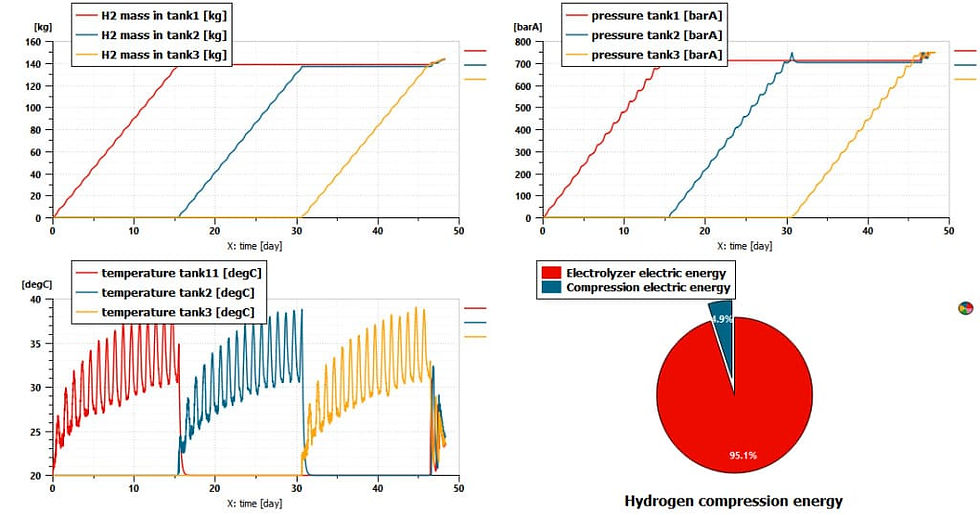
Fig. 13: Hydrogen storage system model results
Conclusions
In conclusion, green hydrogen production simulation within Simcenter Amesim can definitively help address the challenges of green hydrogen production.
The extensive multi-physics simulation platform makes it possible to model complete systems
Sizing the different subsystems, considering various operating conditions is beneficial
It makes it possible to better integrate subsystems and improve the overall performances and ROI
Provides you with a better understanding of the system global behavior
With system simulation, you can better design your system but also evaluate virtually and improve your control strategies
You can finally select the right design at the 1st attempt, reducing risks of errors and accelerating your projects
Finally, Simcenter Amesim, thanks to generic models and libraries makes it possible to address clean hydrogen production but also many other applications. We can mention briefly for instance the following ones:
Design of hydrogen tanks integrated in a vehicle or an aircraft, considering high pressure or cryogenic tanks, simulation of scenarios as refueling or hydrogen extraction.
Evaluation of the performances of aero-engine and gas turbines, analyze the bleed impact on multi-stage compressors, focus on engineering questions analyzing model for off-design and transient assessment.
Design of hydrogen combustion engines, adapt the injection systems and controls, charging systems, combustion controls and after treatment systems.
Fuel cells design and integration with the air and hydrogen supply, the power electronics, the thermal management and controls.

Fig. 14: Examples of Simcenter Amesim capabilities for other applications about hydrogen
About the author:
Patrice Montaland is a Business Developer for Simcenter Amesim. He first gained experience about simulation, fuel cells and hybrid vehicles as an engineer working in the automotive and the hydrogen industries. Patrice joined Siemens 14 years ago, he is now working very closely with the Simcenter Amesim development team, with a real motivation for better addressing the industry new challenges. Patrice strongly believes in the benefits of system simulation for designing green hydrogen production systems and improving the usage of the hydrogen in systems as for instance fuel cells thanks to a fast and comprehensive multi-physics modeling approach.
Ready to advance your green hydrogen production more efficiently and safely? Schedule a meeting with CAEXPERTS and discover how simulation solutions, such as Simcenter Amesim, can help your company optimize systems, reduce risks, and accelerate results in clean energy projects.
WhatsApp: +55 (48) 98814-4798
E-mail: contato@caexperts.com.br


