What’s new in Simcenter Culgi 2511?

The new release of Simcenter Culgi 2511 brings significant advancements to empower your computational chemistry simulation workflows. With enhanced viscosity prediction, you can now achieve reliable results more quickly, with greater accuracy and even the most complex fluids, thereby reducing the need for extensive laboratory testing. The support for realistic crystalline structure modeling unlocks new possibilities for simulating complex materials, while auto-completion for Python scripting and a built-in library of physical constants streamline your workflow and minimize errors. These features collectively enable you to explore more complex systems, accelerate your material development process, and ensure higher precision in your results.
Achieve dependable viscosity predictions validated against industry standards
Measuring viscosity is a complex and time-consuming task, yet it is a critical property across many industries. Traditionally, obtaining accurate viscosity values for different formulations has required extensive lab work and sophisticated experimental setups, often leading to project delays.
With the new release of Simcenter Culgi 2511, you can now leverage state-of-the-art viscosity prediction methodologies, including the impact of shear, at both atomistic and coarse-grained levels. Simcenter Culgi 2511 integrates the SLLOD equation methodology, enabling you to predict viscosity under various conditions with ease. Additionally, the Stop-on-Met precision feature automatically halts measurements once a specified accuracy (such as 0.5%) is achieved, further optimizing your formulation development process. This comprehensive toolkit enables rapid candidate screening and significantly reduces the need for laboratory tests. As a result, you benefit from reliable, industry-standard, validated results, ensuring your predictions are both accurate and dependable. Ultimately, this empowers you to make informed decisions faster and with greater confidence, driving innovation in your projects.
Model realistic crystalline structures with atomic precision
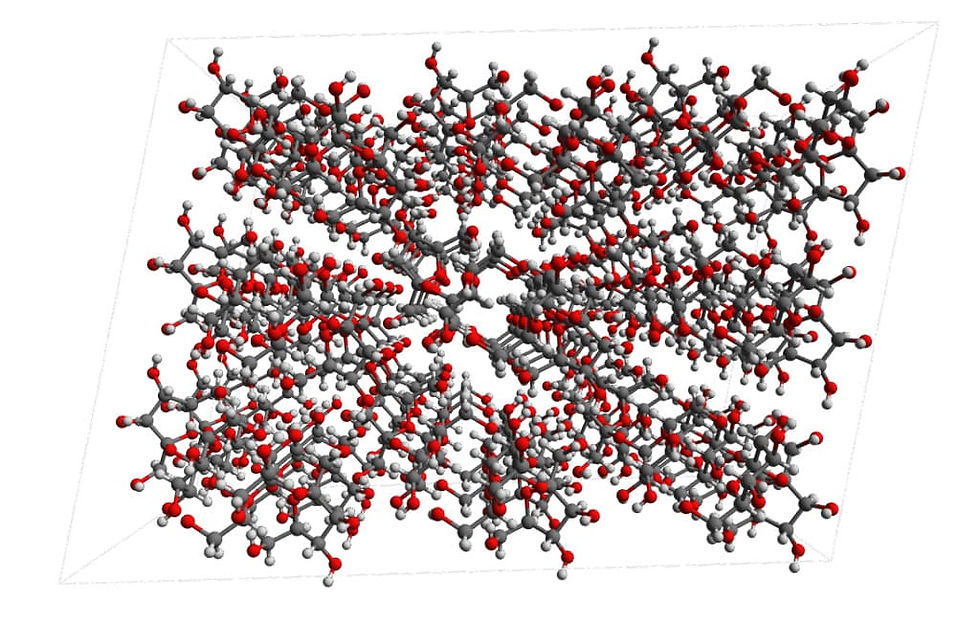
As simulation techniques advance, the demand for modeling increasingly complex systems, such as crystalline structures, continues to grow. The limitations of traditional simulation geometries, often restricted to cubic or rectangular boxes, have made it challenging to accurately represent real-world crystalline forms.
With Simcenter Culgi 2511, you can now import and simulate non-rectangular simulation boxes, overcoming the previous constraints. This new capability allows you to import your unit cell and expand your crystalline structure for simulation, both at the atomistic and coarse-grained levels. By enabling realistic modeling of crystalline structures, you can reduce the need for physical testing and identify potential limitations before moving to experimental phases. This enhancement not only streamlines your workflow but also ensures that your simulations are more representative of actual materials, ultimately leading to better-informed decisions and more successful outcomes.
Accelerate your scripting with 90% reduced command lookup time
Engineers often appreciate the flexibility of exporting and integrating Simcenter Culgi scripts into advanced Python workflows. Remembering the multitude of Simcenter Culgi-specific commands and their functionalities can be a significant hurdle, especially when developing or modifying scripts from scratch.
With the latest Simcenter Culgi 2511 release, you now have access to auto-completion and command help directly within your preferred Python IDE. As you write scripts, you can quickly look up native commands, access help by hovering, and autocomplete commands as needed. This accelerates the development of complex multiscale workflows, reduces the time spent searching for the right commands, and lowers the barrier to entry for new users. The result is a 90% reduction in command lookup time, enabling you to focus on innovation rather than routine tasks. Faster onboarding and improved user experience mean your team can deliver results more efficiently.
Ensure improved calculation precision

Coarse-grained simulations, such as Dissipative Particle Dynamics (DPD), are a hallmark of Simcenter Culgi, but they traditionally lack real units, requiring manual conversion to physical units. This process often involves manually entering physical constants, such as the Boltzmann constant or Avogadro number, which is both tedious and prone to error.
With Simcenter Culgi 2511, you benefit from a built-in library of the most common physical constants used in computational chemistry. Now, you can simply select the required constant and continue building your equations without worrying about transcription errors or loss of precision. This enhancement not only streamlines your workflow but also ensures that your results maintain the highest level of accuracy. By removing a common source of error and saving valuable time, you can develop multiscale workflows with greater confidence and efficiency.
If you want to accelerate your projects, reduce lab testing, and increase the accuracy of your chemical simulations with the latest advancements in Simcenter Culgi 2511, schedule a meeting with CAEXPERTS now and discover how we can support your team in getting the most out of these new features.
WhatsApp: +55 (48) 98814-4798
E-mail: contato@caexperts.com.br


